Home Search
At Home with Team Gabriel
You’ll find our blog to be a wealth of information, covering everything from local market statistics and home values to community happenings. That’s because we care about the community and want to help you find your place in it. Please reach out if you have any questions at all. We’d love to talk with you!
Homes Are More Affordable Today, Not Less Affordable
There’s a current narrative that owning a home today is less affordable than it has been in the past. The reason some are making this claim is because house prices have substantially increased over the last several years.
It’s not, however, just the price of a home that matters.
Homes, in most cases, are purchased with a mortgage. The current mortgage rate is a major component of the affordability equation. Mortgage rates have fallen by over a full percentage point since December 2018. Another major piece of the affordability equation is a buyer’s income. The median family income has risen by approximately 3% over the last year.
The National Association of Realtors (NAR) releases a monthly Housing Affordability Index. The latest index shows that home affordability is better today than at almost any point over the last 30 years. The index determines how affordable homes are based on the following:
“A Home Affordability Index value of 100 means that a family with the median
income has exactly enough income to qualify for a mortgage on a median-
priced home. An index of 120 signifies that a family earning the median
income has 20 percent more than the level of income needed pay the
mortgage on a median-priced home, assuming a 20 percent down payment so
that the monthly payment and interest will not exceed 25 percent
of this level of income (qualifying income).”
The higher the index, therefore, the more affordable homes are. Here is a graph showing the index since 1990:
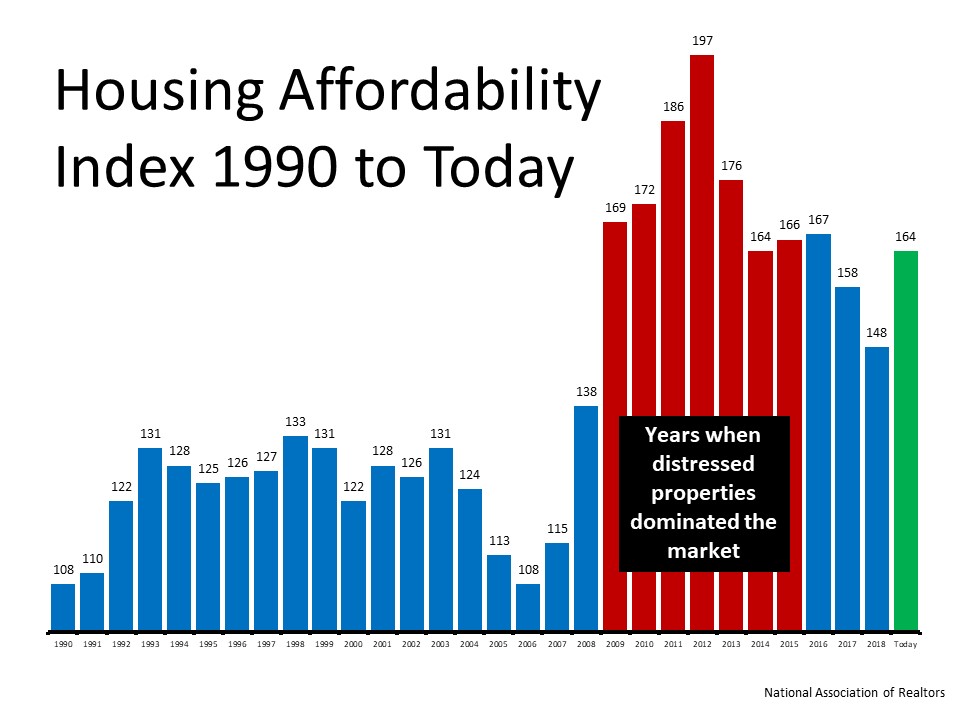
Obviously, affordability was better during the housing crash when distressed properties – foreclosures and short sales – sold at major discounts (2009-2015). Outside of that period, however, homes are more affordable today than any other year since 1990, except for 2016.
The report on the index also includes a section that calculates the mortgage payment on a median priced home as a percentage of the median national income. Historically, that percentage is just above 21%. Here are the percentages since June of 2018:
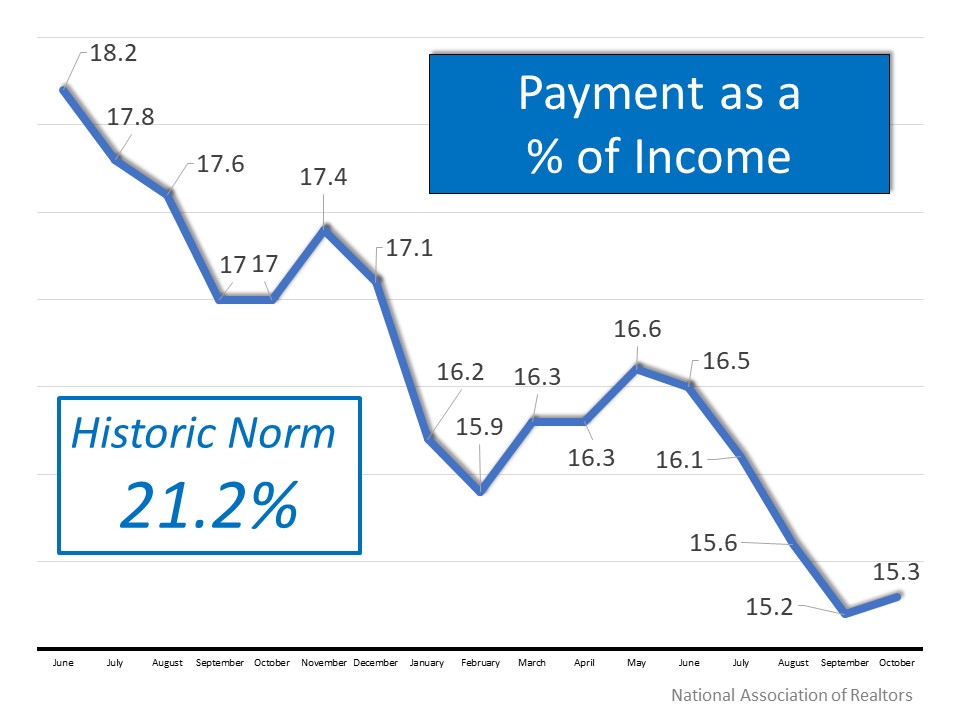
Again, we can see that affordability is much better today than the historical average and has been getting better over the last year and a half.
In Conclusion
Whether you’re thinking about buying your first home or moving up to the home of your dreams, don’t let the false narrative about affordability prevent you from moving forward. From an affordability standpoint, this is one of the best times to buy in the last 30 years.
Homeowners Are Happy! Renters? Not So Much.

When people talk about homeownership and the American Dream, much of the conversation revolves around the financial benefits of owning a home. However, two recent studies show that the non-financial benefits might be even more valuable.
In a recent survey, Bank of America asked homeowners: “Does owning a home make you happier than renting?” 93% of the respondents answered yes, while only 7% said no. The survey also revealed:
- More than 80% said they wouldn’t go back to renting
- 88% agreed that buying a home is the “best decision they have ever made”
- 79% believed owning a home has changed them for the better
Those surveyed talked about the “emotional equity” that is built through homeownership. The study says more than half of current homeowners define a home as a place to make memories, compared to 42% who view a home as a financial investment. Besides building wealth, the survey also showed that homeownership enhances quality of life:
- 67% of current homeowners believed their relationships with family and loved ones have changed for the better since they bought a home
- 78% are satisfied with the quality of their social life
- 82% of homeowners said they were satisfied with the amount of time they spend on their hobbies and passions since purchasing a home
- 75% of homeowners pursued new hobbies after buying a home
Homeowners seem to be very happy.
Renters Tell a Different Story…
According to the latest Zillow Housing Aspirations Report, 45% of renters regret renting rather than buying — more than five times the share of homeowners (8%) who regret buying instead of renting. Here are the four major reasons people regret renting, according to the report:
- 52% regret not being able to build equity
- 52% regret not being able to customize or improve their rentals
- 50% regret that the rent is so high
- 49% regret that they lack private outdoor space
These two studies prove that renting is just not the same as owning.
In Conclusion
There are both financial and non-financial benefits to homeownership. As good as the “financial equity” is, it doesn’t compare to the “emotional equity” gained through owning your own home. Contact our Team for any help if you are buying your next home!
There Are Many Reasons to Buy in the Winter
I’m sharing some of the major benefits of purchasing a home during the winter months.
Want to sell your home? Get a home value report
Want to buy a home? Search all homes for sale
Today I’m discussing some reasons to purchase a home during the wintertime. While others are bundled up inside away from the bitterness, you should be buying a house. Purchasing a new home in the wintertime is not perceived as the typical strategy. However, with low competition, motivated sellers, and tax benefits, you may want to consider searching for a new house now.
Fewer buyers in the marketplace mean fewer fish in the sea. There is less likelihood of multiple offers in the winter. Some sellers are extremely serious now: The available properties for sale are priced to sell, and often sellers will make reductions to sell quicker, so they don’t have to heat their home the whole winter or manage snow removal. You may get a great deal!
Builder incentives are sometimes available too if you’re considering a new construction house. They frequently roll out specials to get some activity in the wintertime. Some specials may be a free fireplace or help with closing costs.
While others are bundled up inside away from the bitterness, you should be buying a house.
Tax benefits are always available when purchasing a new home. Purchasing a home anytime is good for your bottom line when tax time rolls around. You can deduct property taxes, mortgage interest, origination fees on your loan, and interest costs, all while building home equity. These deductions can be a massive money saver, especially in the early years of your loan.
Movers’ availability is also an excellent advantage because their winter calendar typically resembles a ghost town. Not only will you be able to secure movers on short notice, but you can get prime slots like weekends, and probably score a better deal. If you’re considering buying in the chilliest seasons, don’t hold off—consider purchasing in the winter.
If you’re in the market and wondering when to buy a home or investment, get in touch with us. Also, if you have any questions about selling in the winter or real estate in general, call or email us. We would love to help you.
The New Spring Real Estate Market is Here. Are You Ready?

Which month do you think most people who are considering buying a home actually start their search? If you’re like most of us, you probably think the surge happens in the spring, likely in April. Not anymore. According to new research, January 2019 was only 1% behind February for the most monthly views per listing on realtor.com.
So, what does that mean? The busiest season in real estate has just begun.
The same research indicates,
“Historically, April launched the kickoff of the home shopping season as buyers
would come out of their winter hibernation looking for their new home.
However, the spring shopping season now starts in January for many of the
nation’s largest markets.”
With the reality of fewer homes on the market in the winter, and that supply naturally increases as we head to the spring market, waiting for more competition to list in your neighborhood this year might put you behind the curve. Perhaps now is the time to jump into the market.
George Ratiu, Senior Economist at realtor.com says,
“As shoppers modify their strategies for navigating a housing market that has become
more competitive due to rising prices and low inventory, the search
for a home is beginning earlier and earlier.”
There is a lot of speculation in the market about why the search for a home is shifting to an earlier start. The one thing we do know is if you’re thinking about buying or selling a home this year, the earlier you get started, the better.
Reminder: When should you sell something? When there is less of that item for sale and the greatest number of buyers are in the market. That’s exactly what is happening in real estate right now.
Bottom Line
The new spring market for real estate is underway. If you’re considering buying or selling, let’s connect, so you have the advantage in this competitive market.
3 Benefits to Buying Your Dream Home This Year

Outside of a strong economy, low unemployment, and higher wages, there are three more great reasons why you may want to consider buying your dream home this year instead of waiting.
1. Buying a Home is a Great Investment
Several reports indicate that real estate is a good investment, topping other options such as gold, stocks, bonds, and savings. Why? Real estate helps build equity, a form of investing for you and your family. According to CoreLogic’s Equity Report,
“U.S. homeowners with mortgages (roughly 64% of all properties) have seen
their equity increase by a total of nearly $457 billion since the third quarter
2018, an increase of 5.1%, year over year.”
This means the average homeowner gained approximately $5,300 in equity over the past year. If you want to start building your equity, put your housing costs to work for you through homeownership this year.
2. Mortgage Interest Rates Are Low
The Primary Mortgage Market Survey from Freddie Mac indicates that interest rates for a 30-year mortgage have fallen since November 2018 when they hit 4.94%. In their latest forecast, Freddie Mac expects rates to remain low, leveling out to a yearly average of 3.8% in 2020.
When you purchase a home at a low mortgage rate, it will impact your monthly mortgage payment, giving you the opportunity to buy more house for your money.
3. Investing in Your Family is a Win
There are some renters who haven’t purchased a home yet because they’re uncomfortable taking on the obligation of a mortgage. Everyone should realize that, unless you’re living rent-free with your parents, you’re paying a mortgage – either yours or that of your landlord.
Today, rental prices continue to increase, and when you’re paying your landlord’s mortgage instead of your own, you’re not the one earning the equity. As an owner, your mortgage payment is a form of ‘forced savings’ you can use later in life to reinvest in your family. You can use it for a variety of opportunities, such as saving for your children’s education, moving up to a bigger home, or starting your own business. As a renter, it can be more challenging to achieve those types of dreams without home equity working for you.
In Conclusion
Buying a home sooner rather than later could lead to substantial savings and long-term financial growth for you and your family. Let’s get together to determine if homeownership is the right choice for you this year.
The 2020 Real Estate Projections That May Surprise You

This will be an interesting year for residential real estate. With a presidential election taking place this fall and talk of a possible recession occurring before the end of the year, predicting what will happen in the 2020 U.S. housing market can be challenging. As a result, taking a look at the combined projections from the most trusted entities in the industry when it comes to mortgage rates, home sales, and home prices is incredibly valuable – and they may surprise you.
Mortgage Rates
Projections from the experts at the National Association of Realtors (NAR), the Mortgage Bankers Association (MBA), Fannie Mae, and Freddie Mac all forecast mortgage rates remaining stable throughout 2020:

Since rates have remained under 5% for the last decade, we may not fully realize the opportunity we have right now.
Here are the average mortgage interest rates over the last several decades:
- 1970s: 8.86%
- 1980s: 12.70%
- 1990s: 8.12%
- 2000s: 6.29%
Home Sales
Three of the four expert groups noted above also predict an increase in home sales in 2020, and the fourth sees the transaction number remaining stable:

With mortgage rates remaining near all-time lows, demand should not be a challenge. The lack of available inventory, however, may moderate the increase in sales.
Home Prices
Below are the projections from six different expert entities that look closely at home values: CoreLogic, Fannie Mae, Ivy Zelman’s “Z Report”, the National Association of Realtors (NAR), Freddie Mac, and the Mortgage Bankers Association (MBA).

Each group has home values continuing to improve through 2020, with four of them seeing price appreciation increasing at a greater pace than it did in 2019.
Is a Recession Possible?
In early 2019, a large percentage of economists began predicting a recession may occur in 2020. In addition, a recent survey of potential home purchasers showed that over 50% agreed it would occur this year. The economy, however, remained strong in the fourth quarter, and that has caused many to rethink the possibility.
For example, Goldman Sachs, in their 2020 U.S. Outlook, explained:
“Markets sounded the recession alarm this year, and the average forecaster
now sees a 33% chance of recession over the next year. In contrast, our new
recession model suggests just a 20% probability. Despite the record age of the
expansion, the usual late-cycle problems—inflationary overheating and
financial imbalances—do not look threatening.”
Bottom Line
Mortgage rates are projected to remain under 4%, causing sales to increase in 2020. With growing demand and a limited supply of inventory, prices will continue to appreciate, while the threat of an impending recession seems to be softening. It looks like 2020 may be a solid year for the real estate market.
There's a Long Line of Buyers Waiting for Your House

If you’re following what’s happening in the housing market right now, you know that many people believe the winter months aren’t a good time to sell a home.
As realtor.com Senior Economist George Ratiu recently noted,
“Sellers tend to be more reluctant to list during the colder time of year when the market typically makes a seasonal slowdown.”
However, a recent report by ShowingTime reveals how this year is different. Buyer activity is way up compared to the same time last year. The report explains,
“The nation’s 12.6% growth in home showings compared to 2018 was
the most significant jump in buyer traffic during the current four-month streak
of year-over-year increases. The West Region saw the greatest growth in activity,
with a 23.1% jump – the region’s greatest in the history of the Showing Index.”
The increase has spread across all four regions of the country, as the graph below shows:

Bottom Line
Waiting for the “spring buyers’ market” may be a mistake this year. It seems the purchasers are already out and looking to buy.
When a House Becomes a Happy Home

We talk a lot about why it makes financial sense to buy a home, but more often than not we’re drawn to the emotional reasons for homeownership.
No matter the size or shape of a living space, the feeling of a home means different things to different people. Whether it’s a certain scent or a favorite chair, the feel-good connections to our own homes are typically more important to us than the financial ones. Here are some of the reasons why:
1. Owning your home offers stability to start and raise a family
From the best neighborhoods to the top school districts, even those without children at the time of purchase may have this in the back of their minds as a major reason for choosing the location of the home they purchase.
2. There’s no place like home
Owning your own home offers not only safety and security, but also a comfortable place where you can simply relax and kick-back after a long day. Sometimes, that’s just what we need to feel re-charged and truly content.
3. You have more space for you and your family
Whether your family is expanding, an older family member is moving in, or you need to have a large backyard for your pets, you can take all this into consideration when buying your dream home, so the space truly works for you.
4. You have control over renovations, updates, and style
Looking to actually try one of those complicated wall treatments you saw on Pinterest? Tired of paying an additional pet deposit for your apartment building? Maybe you want to finally adopt that fur-baby puppy or kitten you’ve been hoping for. Who’s to say you can’t do all of these things in your own home?
Bottom Line
Whether you’re a first-time homebuyer or a move-up buyer who wants to start a new chapter in your life, now is a great time to reflect on the intangible factors that make a house a happy home.
