At Home with Team Gabriel

You’ll find our blog to be a wealth of information, covering everything from local market statistics and home values to community happenings. That’s because we care about the community and want to help you find your place in it. Please reach out if you have any questions at all. We’d love to talk with you!

April 2, 2019

What You Don’t Know About Your Credit Score… Could Cost You!

Today we are excited to have Nabil Captan as our guest blogger. Nabil is a nationally recognized credit scoring expert, educator, author and producer. In today’s post, he explains how what you don’t know about your credit score could end up costing you. Enjoy!

Informed consumers considering a home purchase today want to do the right thing and plan ahead. Many do not seek immediate professional guidance from a Realtor or a mortgage loan officer. Instead, they hunt for hours online, looking at numerous websites for available homes for sale. They also consult websites to find the best interest rate and terms for future monthly mortgage payments. Many consumers feel betrayed, cheated and at times embarrassed to learn that the credit scores they counted on, to get that specific interest rate for their loan, are not used by mortgage lenders.

When shopping for a good mortgage interest rate, consumers also need to know their credit score, and utilize an online mortgage calculator to compute future monthly mortgage payments. A Google search for “credit score” will yield hundreds of results. The consumer accepts the provider’s terms and conditions to get a free credit score. Terrific! Unaware that in exchange they just received a meaningless credit score that lenders never use. They also handed over their Non-Public Personal Information (NPPI) to that credit score provider for life.

Before we go any further, let’s look at available credit scoring products available to consumers today:

  • FICO credit score from Fair Isaac Corporation/myfico.com, range 300 to 850
  • Plus Score from Experian, range 320 to 830
  • Trans Risk Score from TransUnion, range 300 to 850
  • Equifax Credit Score from Equifax, range 300 to 850
  • Vantage Score from all three bureaus, two ranges, 300 to 850 and 501-990

What is a FICO Score?

In 1958, Bill Fair and Earl Isaac, a mathematician and engineer, formed a company in San Rafael, California. They created tools to help risk managers make a better decision when taking financial risk. Today, 90 percent of all lenders use the FICO score, first created in 1989 by Fair Isaac, and it’s the only score Fannie Mae and Freddie Mac, the Federal Housing Agency and Veterans Affairs will accept in underwriting loans they guarantee.

What is a Consumer Score?

The three credit bureaus, in their understanding of the credit scoring model created by FICO, decided to create their own scoring models, and in 2004 – 2006 they unveiled the “consumer” scores: Plus Score, Trans Risk Score, Equifax Credit Score, and Vantage Score. However, these are not genuine FICO scores, and mortgage lenders don’t use them. Consider this comparison: Would you buy a watch that gives the approximate time of day?

The three credit bureaus work with major financial institutions, professional organizations, comparison sites, personal finance businesses, clubs such as Costco, AAA, Sam’s Club, and many data-mining brokers to bombard consumers in the race of the free credit score mania, all with the enticement of a “consumer” score that is not used by lenders, in hopes of obtaining subscriptions or fees from consumers. Fees that are totally unnecessary!

Know Your Score

Gaining access to one’s own credit report and credit score prior to loan approval with no strings attached could be helpful, and at all times beneficial. With little effort, inaccuracy of information can be instantly corrected at the credit bureau level, and with a few simple steps, credit scores could be enhanced. For example, paying down revolving account balances before a creditor’s statement-ending date (the creditor later updates account information with the credit bureaus), thus reducing revolving account balances at a particular point in time, will positively add more points to a score. It’s priceless.

More Information

Consumers have a legal right to access their annual credit report at no charge once a year from annualcreditreport.com, a site sponsored by the three major credit bureaus: Experian, Equifax and TransUnion.

These reports provide all the basic consumer data, but do not reveal a credit score. If you have a need for the FICO credit score that is actually used by mortgage lenders, myfico.com is the website to visit. For $19.95 per bureau, consumers can purchase a customized credit report with a genuine FICO score.

Additional websites to visit: the Federal Trade Commission (ftc.gov) and the Consumer Financial Protection Bureau (cfpb.gov) for true answers to questions about any financial concepts, financial products, dispute and complaint submissions, and much more.

Today’s homebuyer has instant access to answers. To be relevant in today’s market, real estate professionals need to know the absolute correct response to basic credit questions. It’s important.


Copyright 2014 Nabil Captan, Captan & Company. All rights reserved.

Posted in Market Updates
April 2, 2019

Study: FSBOs Don’t Save Real Estate Commission

One of the main reasons why For Sale By Owners (FSBOs) don’t use a real estate agent is because they believe they will save the commission an agent charges for getting their house on the market and selling it.A new study  by Collateral Analytics, however, reveals that FSBOs don’t actually save anything, and in some cases may be costing themselves more, by not listing with an agent.

In the study, they analyzed home sales in a variety of markets in 2016 and the first half of 2017. The data showed that:

 “FSBOs tend to sell for lower prices than comparable home sales, and in many cases below the average differential represented by the prevailing commission rate.” (emphasis added)

Why would FSBOs net less money than if they used an agent?

The study makes several suggestions:


  • “There could be systematic bias on the buyer side as well. FSBO sales might attract more strategic buyers than MLS sales, particularly buyers who rationalize lower-priced bids on with the logic that the seller is “saving” a traditional commission. Such buyers might specifically search for and target sellers who are not getting representational assistance from agents.” In other words, ‘bargain lookers’ might shop FSBOs more often.
  • “Experienced agents are experts at ‘staging’ homes for sale” which could bring more money for the home.
  • “Properties listed with a broker that is a member of the local MLS will be listed online with all other participating broker websites, marketing the home to a much larger buyer population. And those MLS properties generally offer compensation to agents who represent buyers, incentivizing them to show and sell the property and again potentially enlarging the buyer pool.” If more buyers see a home, the greater the chances are that there could be a bidding war for the property.

Three conclusions from the study:

  1. FSBOs achieve prices significantly lower than those from similar properties sold by Realtors using the MLS.
  2. The differential in selling prices for FSBOs when compared to MLS sales of similar properties is about 5.5%.
  3. The sales in 2017 suggest the average price was near 6% lower for FSBO sales of similar properties.

Bottom Line

If you are thinking of selling, FSBOing may end up costing you money instead of saving you money.


Posted in FSBO
April 2, 2019

Interest Rates Hit New 12 Month Low!

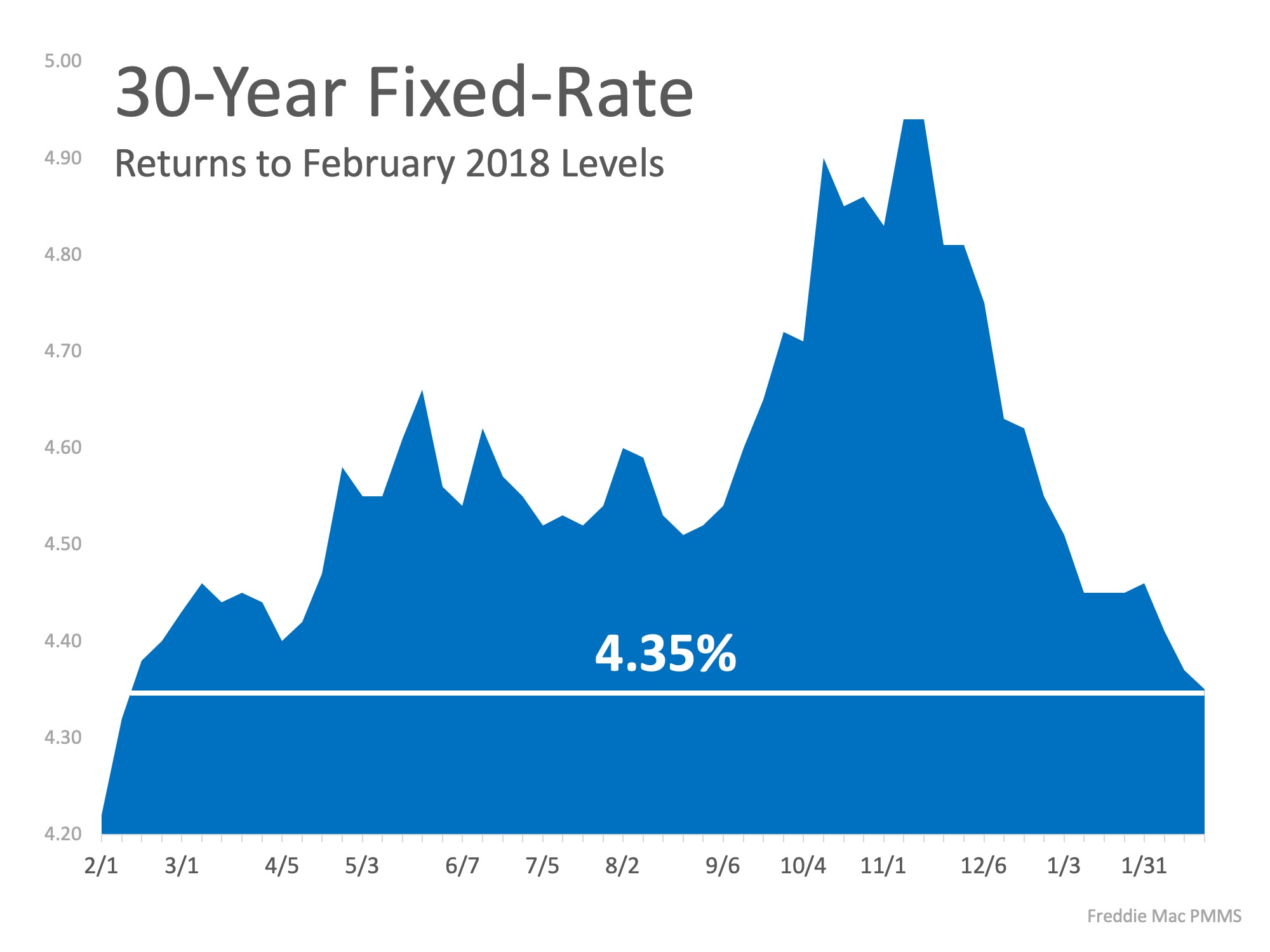
According to Freddie Mac’s Primary Mortgage Market Survey, interest rates for a 30-year fixed rate mortgage are currently at their lowest for 2019. Rates like these haven’t been seen since February 2018!

Last week’s survey results reported an interest rate of 4.35%. This is a welcome change from the near 5% rates seen in mid-November. At 4.32%, the second week of February 2018 was the last time rates were this low. This can be seen in the chart below.

Freddie Mac’s Chief Economist, Sam Khater, had this to say:

“Mortgage rates fell for the third consecutive week, continuing the general downward trend that began late last year.

Wages are growing on par with home prices for the first time in years, and with more inventory available, spring home sales should help the market begin to recover from the malaise of the last few months.”

Bottom Line

If you plan on buying a home this spring, meet with a local real estate professional who can help prepare you for today’s market before rates increase!


Posted in Interest Rates
April 2, 2019

2 Reports That Say Now Is a Great Time to Sell

Heading into the spring buying market, there are strong trends starting to emerge.

The inventory of homes for sale has increased on a year-over-year basis for eight months in a row. Home price appreciation has continued to grow, although at a slower rate. The homeownership rate has reached heights last seen in 2014, with millennials and Generation X leading the way!

Let’s dive a little deeper into some of the recent reports that have been released and what they mean for the spring buying season!

1. National Association of Realtor’s Existing Home Sales Report

Sales of existing homes were down for the third consecutive month in January. Some of this can be explained by the natural seasonality that the real estate market experiences every year, and some can be explained even further by a lack of homes available for sale on the market.

Inventory

For the last eight months, the inventory of homes for sale has been higher when compared to the same month the year before. The challenge in the market is the mismatch of the type of home that is available for sale. First-time homebuyers looking for a starter home are often competing with other buyers to stand out, often outbidding each other.

Lawrence Yun, NAR’s Chief Economist, agrees that the market is still experiencing an inventory shortage.

“In particular, the lower end of the market is experiencing a greater shortage, and more home construction is needed.”

Home Prices

The median home price for homes sold in January was $247,500. This is up 2.8% from January 2018 and marks the 83rd consecutive month of year-over-year gains. The 2.8% growth in home prices represents the smallest year-over-year change since February 2012 but is a welcome change for buyers who had feared being priced out of the market.

Days on the Market

Properties that sold in January were on the market for an average of 49 days with 38% of homes on the market for less than a month.

Yun is positive about how today’s market conditions will help buyers this spring,

 “Existing home sales in January were weak compared to historical norms; however, they are likely to have reached a cyclical low. Moderating home prices combined with gains in household income will boost housing affordability, bringing more buyers to the market in the coming months.”

2. NAR’s Pending Home Sales Report

The national Pending Home Sales Index (PHSI) rose 4.6% to 103.2 in January from 98.7 in December. An index score of 100 is considered normal. All four major regions of the country experienced gains in January, with the largest increase coming in the South

 “The PHSI is a leading indicator for the housing sector, based on pending sales of existing homes. A sale is listed as pending when the contract has been signed but the transaction has not closed, though the sale usually is finalized within one or two months of signing.”

Increases in the PHSI often predict increases in the level of home sales in the coming months, which is great news for the housing market leading in to spring! Yun had this to say,

“Homebuyers are now returning and taking advantage of lower interest rates, while a boost in inventory is also providing more choices for consumers.”

Bottom Line

The housing market in 2019 will require homeowners to list their house at the right price to attract buyers. If interest rates continue to stay low while wages increase, and more inventory comes to market, 2019 could be one of the best years for home sales in recent history.

Posted in Buyers, Sellers
April 2, 2019

What are the Benefits of Becoming a Homeowner?

Every family has a list of important dates. We celebrate birthdays, anniversaries, pet adoptions…and the list goes on. For 64.4 percent of households in the United States, this list includes the day they became a homeowner for the first time!

Why is this date important? Homeownership is not just a roof over your head! It represents shelter, stability, wealth, and pride! For decades, homeownership has been an important part of the American Dream!

However, many question if the next generations see the same benefits of homeownership as their predecessors.

In case we have forgotten, some of those benefits are:

Non-Financial Benefits

1) Educational Achievement: Homeownership has a positive impact on academic achievement, including reading and math performance in children 3-12 years old.

2) Civic Participation: “Owning a home means owning a part of the neighborhood.” Homeowners have a stronger connection to their neighborhood and are more committed to volunteer.

3) Health Benefits: Adjusting for a range of demographic, socioeconomic and housing-related characteristics, homeowners have a substantial health advantage over renters.

4) Public Assistance: The report shows 47% of homeowners use their home equity credit lines to help pay other debts, diminishing their need for public assistance.

5) Property Maintenance and Improvement: A well-maintained home not only generates benefits through consumption and safety, but a high-quality structure also raises mental health.

6) Pride of Ownership: This place is uniquely “yours.” You can customize it according to your likes and personality.

In addition to financial benefits, homeownership also brings significant social benefits. These not only pertain to the family, but extend to the communities, the state, and the country!

Financial Benefits

Buying a home is an investment in your future!

  1. Appreciation: On average, home prices are appreciating annually at a rate of 3.6%. This helps to create a safety net.
  2. Forced Savings: Your mortgage is like a forced savings plan! With each payment, you are reducing the principal of your loan.
  3. Home Equity: Homeownership builds equity every single month. You can later use that equity to start a business, send your children to college, etc.
  4. Net Worth: A homeowners’ net worth is 44x greater than renters! This gives you the financial freedom to invest.
  5. Stability: Rent prices increase 4% annually! A fixed mortgage payment allows you to save for future projects and guard against inflation.
  6. Tax Benefits: The government has created tax benefits to encourage customers to purchase. (Talk to your CPA to see which benefits apply to you).

Bottom Line

Homeownership is and will always be part of the American Dream! There are many financial and non-financial benefits to take advantage of when owning a home. If owning a home is part of your dream, contact a local real estate professional to help you with the process!

Posted in Buyers
April 2, 2019

Millionaire To Millennials: Don’t Get Stuck Renting A Home… Buy One!

In a CNBC article, self-made millionaire David Bach explained that: “The biggest mistake millennials are making is not buying their first home.” He goes on to say that, “If you want to build real financial security, real wealth for your lifetime, then you need to buy a home.”

Bach went on to explain:

“Homeowners are worth 40 times more than renters. Now, that first home doesn’t need to be a dream home, it can be a very small home. You might literally have to buy a small studio apartment, but that’s how you get started.”

Then he explains the secret to buying that home!

“Don’t do a 30-year mortgage. You want to take that 30-year mortgage and instead pay it off early, do a 15-year mortgage. What happens if you do a 15-year mortgage? Well, one, you pay the mortgage off 15-years sooner, that means you’ll be able to retire in your fifties. Number two, you’ll save a fortune (on potentially hundreds of thousands of dollars in interest payments).”

What will it cost to pay your mortgage in fifteen years? He explains further:

“For fifteen years, you got to brownbag your lunch. Think about that! Brownbag your lunch literally for fifteen years. You can retire ten years sooner than your friends. You’ll have real wealth, because you bought a home – you’re not a renter. And you’ll be financially secure for life.”

Bottom Line

Whenever a well-respected millionaire gives investment advice, people usually clamor to hear it. This millionaire gave simple advice – if you don’t yet live in your own home, go buy one.

Who is David Bach?

Bach is a self-made millionaire who has written nine consecutive New York Times bestsellers. His book, “The Automatic Millionaire,” spent 31 weeks on the New York Times bestseller list. He is one of the only business authors in history to have four books simultaneously on the New York Times, Wall Street Journal, BusinessWeek and USA Today bestseller lists.

He has been a contributor to NBC’s Today Show, appearing more than 100 times, as well as a regular on ABC, CBS, Fox, CNBC, CNN, Yahoo, The View, and PBS. He has also been profiled in many major publications, including the New York Times, BusinessWeek, USA Today, People, Reader’s Digest, Time, Financial Times, Washington Post, the Wall Street Journal, Working Woman, Glamour, Family Circle, Redbook, Huffington Post, Business Insider, Investors’ Business Daily, and Forbes.

Posted in Buyers
Feb. 5, 2019

Harvest View 20190205

Jan. 14, 2019

Harvest View 20190114

Jan. 11, 2019

Harvest View 20190111

Jan. 3, 2019

Chapman Chase 20190103