At Home with Team Gabriel

You’ll find our blog to be a wealth of information, covering everything from local market statistics and home values to community happenings. That’s because we care about the community and want to help you find your place in it. Please reach out if you have any questions at all. We’d love to talk with you!

Oct. 30, 2020

Home Values Projected to Keep Rising

As we enter the final months of 2020 and continue to work through the challenges this year has brought, some of us wonder what impact continued economic uncertainty could have on home prices. Looking at the big picture, the rules of supply and demand will give us the clearest idea of what is to come.

Due to the undersupply of homes on the market today, there’s upward pressure on prices. Consider simple economics: when there is high demand for an item and a low supply of it, consumers are willing to pay more for that item. That’s what’s happening in today’s real estate market. The housing supply shortage is also resulting in bidding wars, which will also drive price points higher in the home sale process.

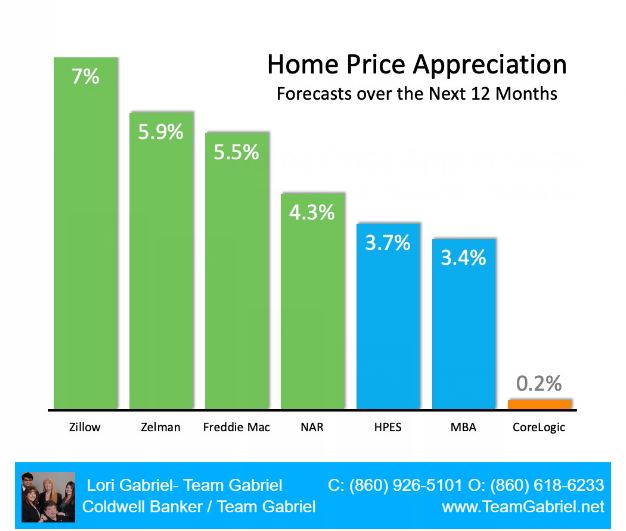
There’s no evidence that buyer demand will wane. As a result, experts project price appreciation will continue over the next twelve months. Here’s a graph of the major forecasts released in the last 60 days:
I hear many foreclosures might be coming to the market soon. Won’t that drive prices down?

Some are concerned that homeowners who entered a mortgage forbearance plan might face foreclosure once their plan ends. However, when you analyze the data on those in forbearance, it’s clear the actual level of risk is quite low.

Ivy Zelman, CEO of Zelman & Associates and a highly-regarded expert in housing and housing-related industries, was very firm in a podcast last week:

“The likelihood of us having a foreclosure crisis again is about zero percent.”

With demand high, supply low, and little risk of a foreclosure crisis, home prices will continue to appreciate.

In Conclusion 

Originally, many thought home prices would depreciate in 2020 due to the economic slowdown from the coronavirus. Instead, prices appreciated substantially. Over the next year, we will likely see home values rise even higher given the continued lack of inventory of homes for sale.

Posted in Buyers, Sellers
Oct. 30, 2020

Buyer Interest Is Growing among Younger Generations

The demand for homes this year is extraordinary as record-breaking numbers of hopeful buyers continue to shop for homes. In a normal year, the peak homebuying season comes to a close by early fall. However, 2020 is anything but a normal year, and the housing market is no exception. Lawrence Yun, Chief Economist for the National Association of Realtors (NAR), explains:

“Home sales traditionally taper off toward the end of the year, but in September they surged beyond what we normally see during this season…I would attribute this jump to record-low interest rates and an abundance of buyers in the marketplace, including buyers of vacation homes given the greater flexibility to work from home.”

What’s drawing so many buyers to the market?

As Yun mentioned, record-low interest rates are key. Today’s rates are strengthening purchasing power for buyers, too. Sam Khater, Chief Economist at Freddie Mac, emphasizes:

“Mortgage rates today are on average more than a full percentage point lower than rates over the last five years.”

If you’re a homebuyer right now, there’s no question that you want to take advantage of this opportunity – and you’re not alone. Competition among buyers is definitely increasing as more buyers enter the market and mortgage interest rates remain so low.

Who’s planning to buy a home right now?

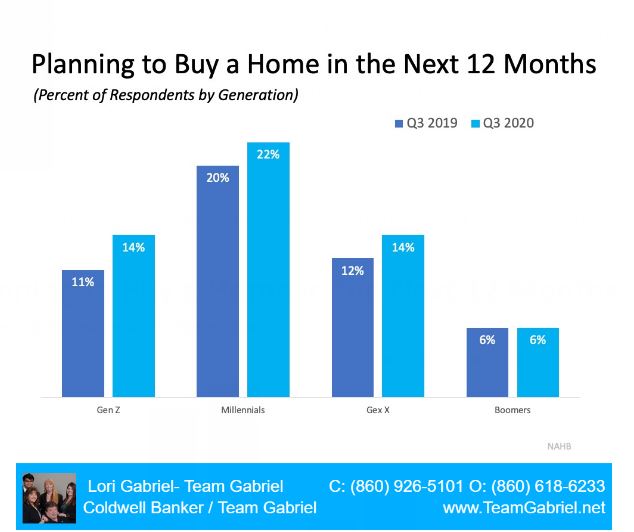
Today’s affordability is appealing to all generations and seems to be especially attractive to younger buyers who want to begin growing their wealth through homeownership. There’s a distinct increase this year in the percentage of those in younger generations searching for homes. The National Association of Home Builders (NAHB) notes:

“Between the third quarters of 2019 and 2020, the share of Gen Z adults planning a home purchase rose three points to 14%. Millennials, however, are the generation most likely to be considering buying a home (22%).”

Here’s a graph showing the year-over-year increase in homebuying interest by generation:

According to Mark Fleming, Chief Economist for First American, millennials are reaching their prime home-buying years, a likely driver in this increase:

“Record low mortgage rates and millennials continuing to age into their prime home-buying years has boosted demand, but a lack of housing supply remains a challenge.”

What’s the biggest challenge for today’s buyers?

Finding a home, however, as Fleming notes above, is clearly a challenge today. Yun also explains:

“There is no shortage of hopeful, potential buyers, but inventory is historically low.”

With so many buyers actively searching for homes this year and so few houses for sale, it’s more important than ever to work with a trusted real estate professional to navigate today’s market. From pre-approval to bidding wars and guidance on down payment assistance resources, having an agent by your side might make the difference in your ability to land your dream home.

In Conclusion

Let’s connect if you’re ready to buy a home. More buyers mean more competition, so you need an expert guide to help you stand out from the crowd. Our Trusted Real Estate Professional's here at Team Gabriel can help you through the entire process. 


Posted in Buyers, Sellers
Oct. 29, 2020

Is it Time to Move into a Single-Story Home?

Once the kids have left the nest, you may be wondering what to do with all of the extra space in your home. Chances are, you don’t need four bedrooms anymore, and it may be a great time to sell your house and downsize, maybe even into a single-story home. You’ve likely gained significant equity if you’ve lived in your home for a while, so making a move while demand for your current house is high could be your best step forward toward the retirement goals you set out to achieve several years ago.

The dilemma, though, is where to go next. A big concern for many homeowners who are ready to sell is finding a home to move into, given today’s lack of houses available for sale. There is, however, some good news: the number of single-family 1-story homes being built today is on the rise, improving your odds of finding the right home for your changing needs. In a recent article, The National Association of Home Builders (NAHB) explains:

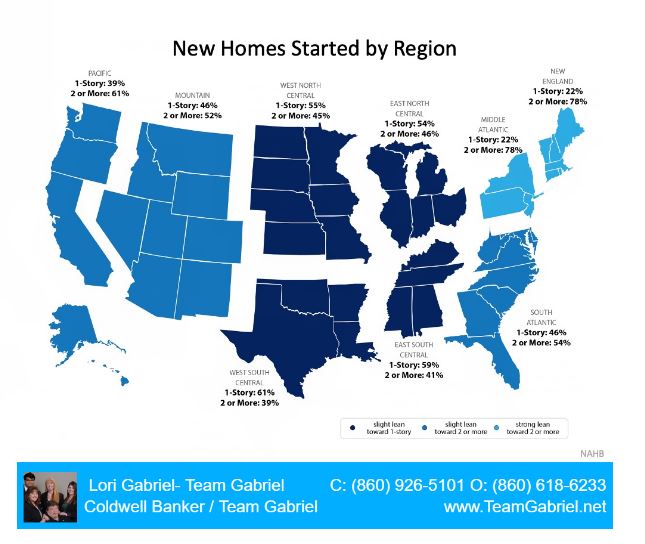
“Nationwide, the share of new homes with two or more stories fell from 53% in 2018 to 52% in 2019, while the share of new homes with one story grew from 47% to 48%.”

Here’s a map showing the breakdown of newly constructed homes being built by region, and the percentage of 1-story and 2-story homes in that mix:

What are the benefits of buying a one-story home?

Still not sure about buying a single-story home? An article from Home Talk covers several advantages of switching from two floors to one:

1. Energy Efficient

“It is easier to heat and cool a single-story house [than] it would be to regulate the temperatures of a multi-story house.”

Most single-story homes only need one heating or cooling unit, and they typically stay cooler than a two-story home, both of which can lead to significant savings.

2. Easier to Maintain

“Doing a general cleaning in a single story requires less effort and you will be able to see all areas that need cleaning and the areas are easily accessible.”

Cleaning and maintenance of a single-story home can take less time and effort, and better upkeep helps improve the overall value of the home.

3. Accessible for Everyone

“A single-story house can be accessed by anyone, whether they are young children or the senior citizens.”

If you’re looking for a house that provides a safe and easily accessible environment at any age, a single-story home may be optimal.

4. Good Resell Potential

“When buying a single-story house, you should consider the resale value should you think of reselling it in case of a circumstance that can happen. Look at the growth rate of that area. Due to the high demand of these types of houses it is [easy] to resell them and depending on the growth rate of an area, it increases in value significantly.”

Single-story homes have a lot of benefits and are often in higher demand. This bodes well for future resale opportunities.

In Conclusion 

There are many benefits to downsizing into a one-story home. Doing so while demand for your current house is high might make it easier than ever to make a move. Let’s connect if you’re ready to purchase the single-story home you need while homes are so affordable today. If you are Considering Making a Move, Call Our Team Today! (860) 618-6233!

Posted in Buyers, Sellers
Oct. 28, 2020

Why Pricing Your House Right Is Essential

In today’s real estate market, setting the right price for your house is one of the most valuable things you can do.

According to the U.S. Economic Outlook by the National Association of Realtors (NAR), existing home prices nationwide are forecasted to increase 4.7% in 2020 and 4.1% in 2021. This means experts anticipate home values will continue climbing into next year. Today, low inventory is largely keeping prices from depreciating. Danielle Hale, Chief Economist at realtor.com, notes:

“Looking at the sheer number of buyers, low mortgage rates, and limited sellers, the strength of home prices–which are now growing at the highest pace since January 2018–makes sense.”

When it comes to pricing your home, the goal is to increase visibility and drive more buyers your way. Instead of trying to win the negotiation with one buyer, you should price your house so that demand is maximized and more buyers want to take a look.

How to Price Your Home

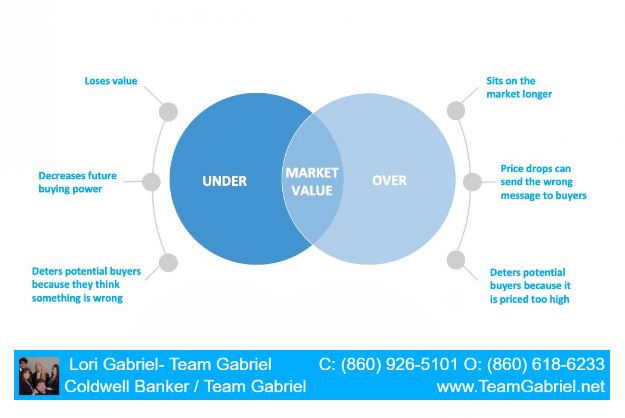
As a seller, you might be thinking about pricing your house on the high end while so many of today’s buyers are searching harder than ever just to find a home to purchase. You’re thinking, higher price, greater profit, right? But here’s the thing – a high price tag does not mean you’re going to cash in big on the sale. It’s actually more likely to deter buyers and have them looking at the houses your neighbors are selling instead.

Even today, when the advantage tips toward sellers because there are so few houses for sale, your house is more likely to sit on the market longer or require a price drop that can send buyers running in the other direction if it isn’t priced just right.

Team Gabriel's Trusted Professionals Will Help

It’s important to make sure your house is priced correctly by working in partnership with Team Gabriel, When you price it competitively, you won’t be negotiating with one buyer over the price. Instead, you’ll have multiple buyers competing for the home, and that’s what ultimately increases the final sale price.

The key is making sure your house is priced to sell immediately. That way, it will be seen by the most buyers. More than one of them may be interested, and your house will be more likely to sell at a competitive price.

In Conclusion

If you’re thinking about listing your house this fall, let’s discuss how to price it right so you can maximize your exposure and your return. With our Extensive Marketing Plan, Professional Listing Photos, Drone Video, & 3D Virtual Walkthrough's We can Sell Your Home FAST!

Are you curious what your House is Worth in Today's Market? CALL Today for a FREE No-Obligation Market Value of Your Home!

Call (860) 618-6233!


Posted in Sellers
Oct. 27, 2020

Do You Have Enough Money Saved for a Down Payment?

One of the biggest misconceptions for first-time homebuyers is how much you’ll need to save for a down payment. Contrary to popular belief, you don’t always have to put 20% down to buy a house. Here’s how it breaks down.

A recent survey by Point2Homes mentions that 74% of millennials (ages 25-40) say they’re interested in purchasing a home over the next 12 months. The study notes, “88% say they have significantly less savings than the average national down payment amount, which is $62,600.”

Thankfully, $62,600 is not the amount every buyer needs for a down payment in the United States. There are many different options available, especially for first-time homebuyers (millennial or not). That amount can also be significantly less, depending on the purchase price of the house.

According to the National Association of Realtors (NAR), “The median existing-home price for all housing types in August was $310,600.” (These are the latest numbers available). NAR also indicates that:

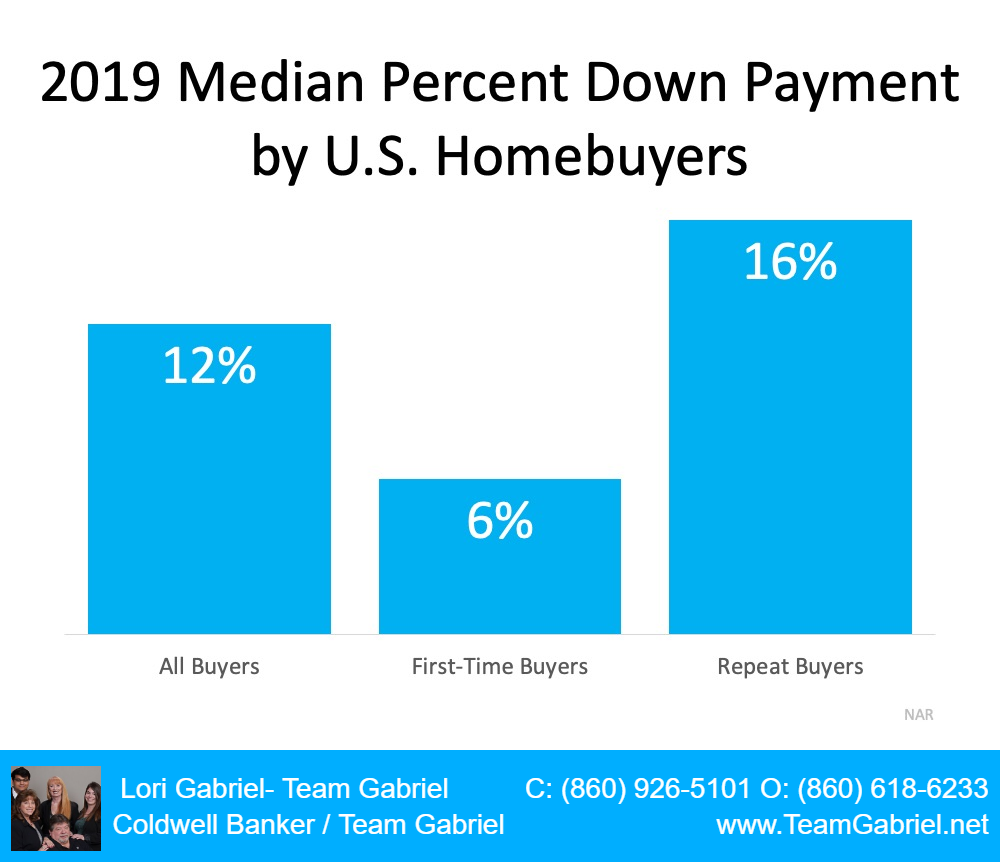
“In 2019, the median down payment was 12 percent for all buyers, six percent for first-time buyers, and 16 percent for repeat buyers.” (See graph below):

That means if a qualified first-time buyer purchases a home at today’s median price, $310,600, with a 6% down payment, in reality, the down payment only amounts to $18,636. That’s nowhere near $62,600.

Knowing there are also programs like FHA where the down payment can be as low as 3.5% of the purchase price for a first-time buyer, that up-front cost could be significantly less – as little as $10,871 for the same home noted above. There are also other programs like USDA and loans for Veterans that waive down payment requirements.

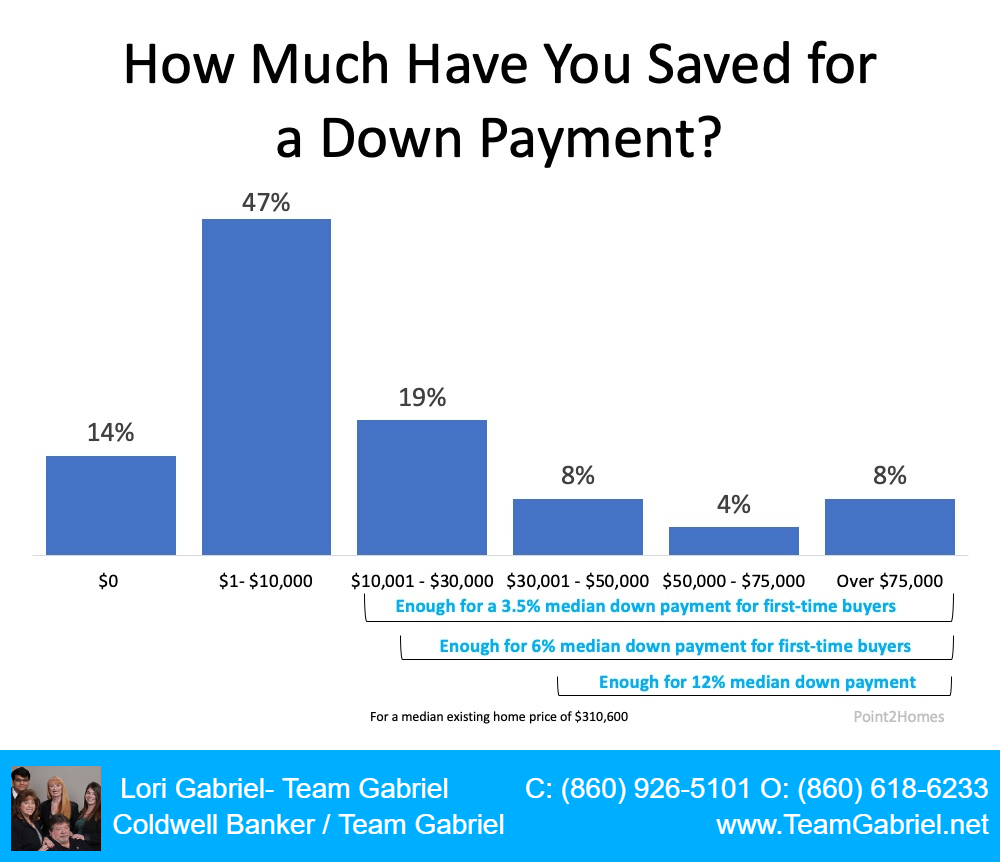
The Point2Homes study also shares how much millennials have indicated they’ve saved for a down payment. As we can see in the graph below, 39% have already saved enough for a down payment on a median-priced home. Another 47% are close to reaching that goal, depending on the purchase price of the home.

Unfortunately, the lack of knowledge about the homebuying process is keeping many motivated first-time buyers on the sidelines. That’s why it’s important to contact Team Gabriel to understand the requirements in your local area if you want to buy a home. Our Trusted Agents and a lender can guide you through the process. If you are interested in learning more about your options, Call Our Team Today! (860) 618-6233!

In Conclusion 

Be careful not to let big myths about homebuying keep you and your family out of the housing market. Let’s connect to discuss your options today, Feel Free to Contact Our Team for any information! 

Posted in Buyers
Oct. 27, 2020

Two Important Impacts of Home Equity

Equity continues to rise, helping American homeowners secure a much more stable financial future. According to the most recent data from CoreLogic, the average homeowner gained $9,800 in equity over the past year. In addition, experts project 2020 home prices to continue rising. With prices going up, equity gains will also keep accelerating. Black Knight just reported:

“The annual percent change in the overall median existing single-family-home price has skyrocketed in the past several months, with recent numbers at three to five times higher than rates seen in the past several years.”

Jeff Tucker, Senior Economist at Zillow, just qualified recent price increases as “jaw-dropping” and “within a hair’s breadth of double-digit year-over-year appreciation.”

Knowing equity will help enable many homeowners to better survive the economic distress caused by the ongoing pandemic, it’s important to break down two key homeowner benefits of increasing equity.

1. Equity Increases a Homeowner’s Options to Buy a New Home

Aside from the financial damage of the last seven months, there has also been a tremendous emotional toll on many people. Shelter-in-place mandates, quarantine requirements, and virtual schooling have all made us re-evaluate the must-have requirements a home should deliver. Having equity in your current house gives you a better opportunity to move-up or build your perfect home from scratch.

Mark Fleming, Chief Economist at First American, recently explained:

“As homeowners gain equity in their homes, they are more likely to consider using that equity to purchase a larger or more attractive home – the wealth effect of rising equity.”

If you need to make a move, the equity in your current home can help make that possible – right now.


2. Equity Enables Homeowners to Help Future Generations

An increase in home equity grows overall wealth, which can transfer to future generations. The Federal Reserve, in an addendum to their recent Survey of Consumer Finances, explains:

“There are numerous ways families can transmit wealth and resources across generations. Families can directly transfer their wealth to the next generation in the form of a bequest. They can also provide the next generation with inter vivos transfers (gifts), for example, providing down payment support to enable a home purchase or a substantial wedding gift.”

The Federal Reserve also explains another way wealth (including the additional net worth generated by an increase in home equity) can benefit future generations:

“In addition to direct transfers or gifts, families can make investments in their children that indirectly increase their wealth. For example, families can invest in their children’s educational success by paying for college or private schools, which can in turn increase their children’s ability to accumulate wealth.”

In Conclusion 

Equity can help a homeowner grow their confidence in a more stable financial future. It provides near-term move-up options and creates a positive impact for future generations. In many cases, the largest single investment a person has is their home. As that investment appreciates in value, financial options increase too. If you are interested in learning about all of your options, For a FREE NO-Obligation Market Analysis of Your Home's Value,

Call the Team That's Dedicated to Results! (860) 618-6233!

Posted in Buyers, Sellers
Oct. 26, 2020

138 Trotters Way, Torrington CT

Posted in Video Clips
Oct. 22, 2020

NEW Listing! 101 Fairview Ave

Posted in Video Clips
Oct. 14, 2020

The #1 Reason Not to Wait to List Your House for Sale

Many industries have been devastated by the economic shutdown caused by the COVID-19 virus. Real estate is not one of them.
Mark Fleming, Chief Economist for First American, just reported:

“Since hitting a low point during the initial stages of the pandemic, the only major industry to display immunity to the economic impacts of the coronavirus is the housing market. Housing has experienced a strong V-shaped recovery and is now exceeding pre-pandemic levels.”

Buyer demand is still strong heading into the fall. ShowingTime, which tracks the average number of buyer showings on residential properties, just announced that buyer showings are up 61.9% compared to the same time last year. They went on to say:

“Normally, real estate activity begins to slow down in the late summer, but this year it peaked in July, August and into September.”

There Is One Big Challenge

Purchaser demand is so high, the market is running out of available homes for sale. Just last week, realtor.com reported:

“Since the beginning of the COVID pandemic in March, nearly 400,000 fewer homes have been listed compared to last year, leaving a gaping hole in the U.S. housing inventory.”

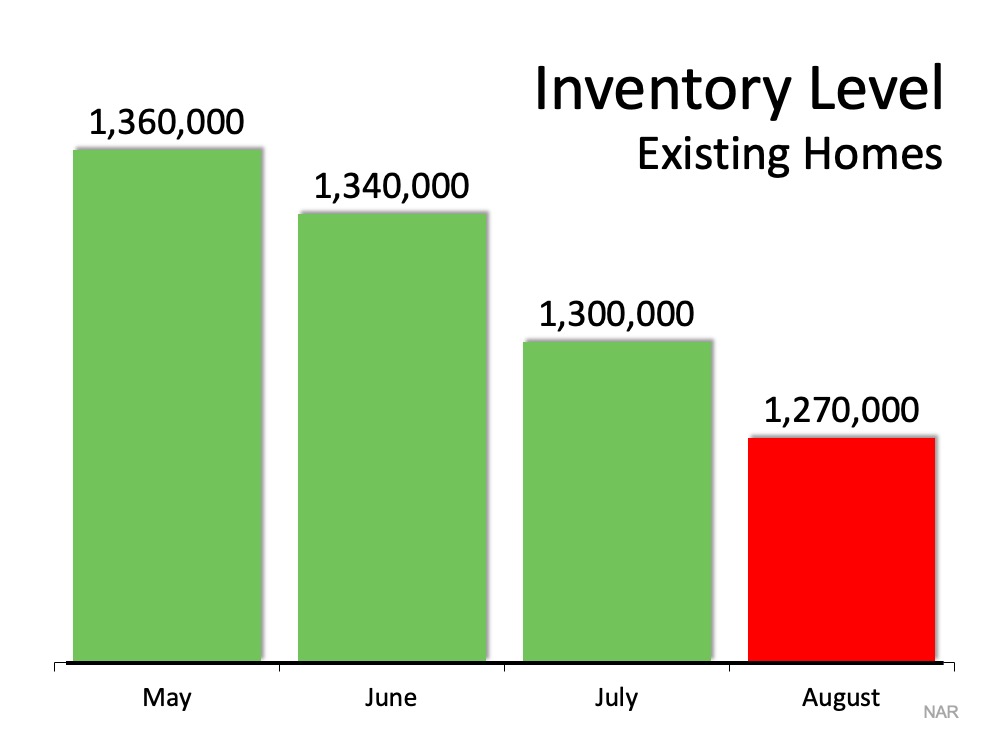
The National Association of Realtors (NAR) revealed that, while home sales are skyrocketing, the inventory of existing homes for sale is dropping dramatically. Below is a graph of existing inventory (September numbers are not yet available):

Homebuilders are increasing construction, but they cannot keep up with the high demand. Bill McBride, founder of the Calculated Risk blog, in discussing inventory of newly constructed houses, notes:

“The months of supply decreased to 3.3 months...This is the all-time record low months of supply.”

What does this mean for sellers?

Anyone thinking of putting their home on the market should not wait. A seller will always negotiate the best deal when demand is high and supply is limited. That’s exactly the situation in the real estate market today.

Next year, when the pandemic is hopefully behind us, there will be many more properties coming to the market. Don’t wait for that increase in competition in your neighborhood. Now is the time to sell.

In Conclusion 

Let’s connect today to get your house on the market at this optimal time to sell. If you are considering a Move, Call Team Gabriel Today! It is a HOT Market, NOW is the Time to BUY or SELL.

For a FREE No Obligation Market Analysis of Your Home's Value. Call (860) 618-6233!!

Posted in Market Updates, Sellers
Oct. 13, 2020

6 Reasons You’ll Win by Selling with a Real Estate Agent This Fall

There are many benefits to working with a real estate professional when selling your house. During challenging times, like what we face today, it becomes even more important to have an expert you trust to help guide you through the process. If you’re considering selling on your own, known in the industry as a For Sale by Owner (FSBO), it’s critical to consider the following:

1. Your Safety Is a Priority

Your family’s safety should always come first, and that’s more crucial than ever given the current health situation in our country. When you FSBO, it is incredibly difficult to control entry into your home. A real estate professional will have the proper protocols in place to protect not only your belongings but your family’s health and well-being too. From regulating the number of people in your home at one time to ensuring proper sanitization during and after a showing, and even facilitating virtual tours for buyers, real estate professionals are equipped to follow the latest industry standards recommended by the National Association of Realtors (NAR) to help protect you and your family.

2. A Powerful Online Strategy Is a Must to Attract a Buyer

Recent studies from NAR have shown that, even before COVID-19, the first step 44% of all buyers took when looking for a home was to search online. Throughout the process, that number jumps to 93%. Today, those numbers have grown exponentially. Most real estate agents have developed a strong Internet and social media strategy to promote the sale of your house. Have you?

3. There Are Too Many Negotiations

Here are just a few of the people you’ll need to negotiate with if you decide to FSBO:

  • The buyer, who wants the best deal possible
  • The buyer’s agent, who solely represents the best interest of the buyer
  • The inspection companies, which work for the buyer and will almost always find challenges with the house
  • The appraiser, if there is a question of value

As part of their training, agents are taught how to negotiate every aspect of the real estate transaction and how to mediate the emotions felt by buyers looking to make what is probably the largest purchase of their lives.

4. You Won’t Know if Your Purchaser Is Qualified for a Mortgage

Having a buyer who wants to purchase your house is the first step. Making sure they can afford to buy it is just as important. As a FSBO, it’s almost impossible to be involved in the mortgage process of your buyer. A real estate professional is trained to ask the appropriate questions and, in most cases, will be intimately aware of the progress being made toward a purchaser’s mortgage commitment.

Further complicating the situation is how the current mortgage market is rapidly evolving because of the number of families out of work and in mortgage forbearance. A loan program that was available yesterday could be gone tomorrow. You need someone who is working with lenders every day to guarantee your buyer makes it to the closing table.

5. FSBOing Has Become More Difficult from a Legal Standpoint

The documentation involved in the selling process has increased dramatically as more and more disclosures and regulations have become mandatory. In an increasingly litigious society, the agent acts as a third-party to help the seller avoid legal jeopardy. This is one of the major reasons why the percentage of people FSBOing has dropped from 19% to 8% over the last 20+ years.

6. You Net More Money When Using an Agent

Many homeowners believe they’ll save the real estate commission by selling on their own. Realize that the main reason buyers look at FSBOs is because they also believe they can save the real estate agent’s commission. The seller and buyer can’t both save on the commission.

A study by Collateral Analytics revealed that FSBOs don’t actually save anything by forgoing the help of an agent. In some cases, the seller may even net less money from the sale. The study found the difference in price between a FSBO and an agent-listed home was an average of 6%. One of the main reasons for the price difference is effective exposure:

“Properties listed with a broker that is a member of the local MLS will be listed online with all other participating broker websites, marketing the home to a much larger buyer population. And those MLS properties generally offer compensation to agents who represent buyers, incentivizing them to show and sell the property and again potentially enlarging the buyer pool.”

The more buyers that view a home, the greater the chance a bidding war will take place.

In Conclusion 

Listing on your own leaves you to manage the entire transaction by yourself. Why do that when you can hire an agent and still net the same amount of money? Before you decide to take on the challenge of selling your house alone, let’s connect to discuss your options.


Posted in FSBO